


Glass has become the defining material of Dubai’s built environment. From high-rise façades and luxury villas to corporate fit-outs and retail interiors, it functions as both a structural component and an architectural statement. Yet for all its visibility, the standard of detailing required to install it correctly is frequently underestimated, and the consequences of that oversight are well documented.
A recent audit conducted by the Dubai Municipality Building Control Department reported that more than 30% of façade defects identified across inspected projects were attributable to installation, not to the glass material itself. The implication is significant: the majority of glass failures observed in the emirate are preventable. They originate in inaccurate site measurements, incorrect material specification, unsuitable sealant selection, and the engagement of contractors without the technical competence the work demands.
For developers, project managers, fit-out specialists, and interior designers commissioning glass work in Dubai, the consequences extend well beyond the immediate cost of rectification. Delayed handovers, contested warranties, regulatory non-compliance, and, in more serious cases, safety liabilities can compromise the integrity of an entire project. The following guide examines the 10 most common detailing mistakes observed across glass and aluminium works in Dubai projects, and outlines the practical measures by which each can be avoided.
Why Glass Detailing in Dubai Is Uniquely Demanding
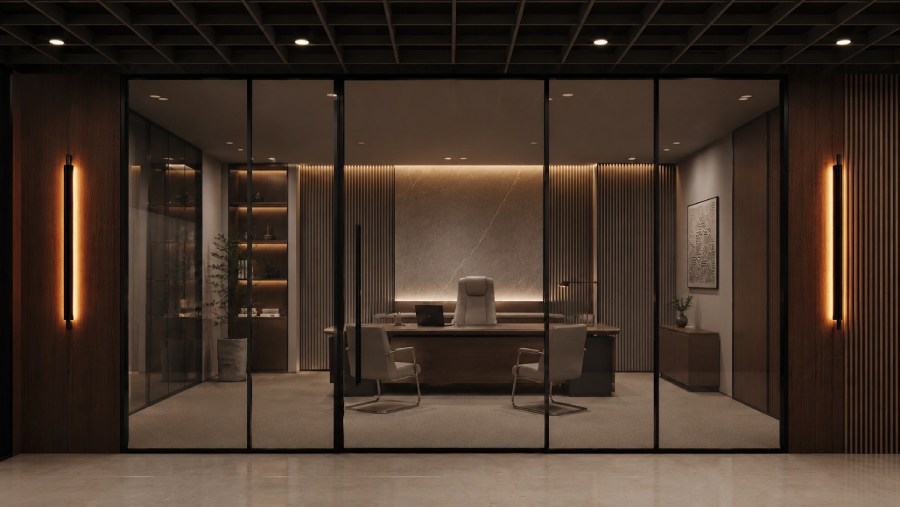
Glass behaves differently in Dubai than in almost any other commercial market. Surface temperatures on west-facing façades can exceed 70°C during peak summer months, and ultraviolet exposure across the Gulf region runs approximately 20% higher than the global average. Coastal humidity introduces salt-laden air that accelerates corrosion at every metal-to-glass interface, while seasonal sandstorms abrade exposed surfaces and degrade sealants well before the end of their rated lifespan.
Compressed construction schedules compound the technical challenge. Dubai projects routinely move from tender to handover at a pace that leaves little tolerance for rework, and extended sub-contracting chains frequently dilute accountability for the finished detail. Understanding this environment is the foundation of every specification decision that follows, and the primary reason that the recurring detailing failures observed across the city are rarely cosmetic in consequence.
#1: Taking Site Measurements Too Early
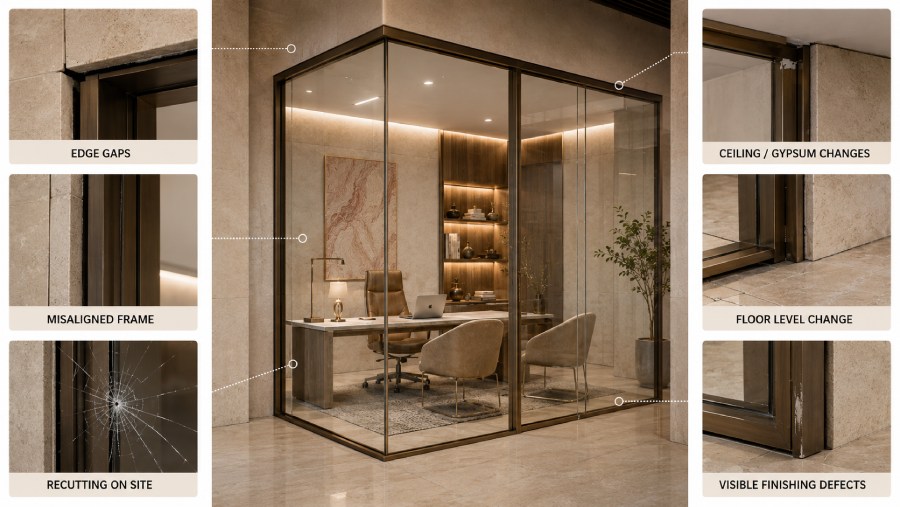
Premature site measurement is among the most repeated glass installation mistakes Dubai contractors make. The consequence sequence is consistent: edge gaps, forced installations, recutting on site, programme delays, and visible finishing defects at handover. Surveys taken before the flooring, ceiling, gypsum, and aluminium frames are complete invariably capture a site that no longer exists when the glass arrives. Drawing dimensions are routinely assumed to match site reality, even where wall unevenness, slab variation, and unaccounted finished floor-level changes have already invalidated them. Industry repair documentation across Dubai also links inaccurate measurement to drafts, leaks, repeated breakage, and compounding repair costs over the warranty period.
Among the more practical glass detailing tips for Dubai projects is to defer the final survey until major finishes are signed off. Cross-check floor, ceiling, and wall levels at each opening, mark door swings, aluminium frame lines, and hardware points on site, and release fabrication only against approved shop drawings.
#2: Specifying Glass Type and Thickness Without Studying the Application
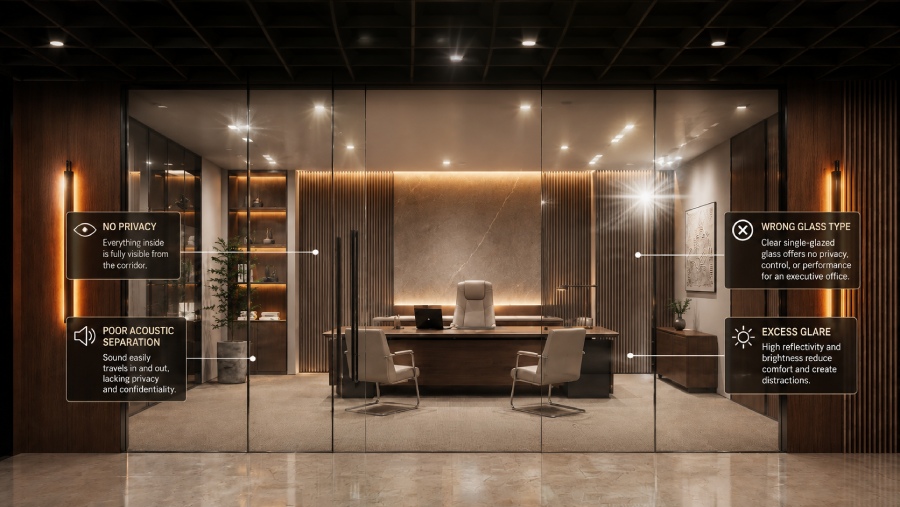
Material specification errors, covering both glass type and panel thickness, account for a disproportionate share of premature failures observed across glass work in Dubai. Annealed glass is still installed where toughened or laminated specification is mandatory under Dubai Civil Defence safety codes, most commonly in low-level glazing, doors, and balustrades. On exterior elevations, single-glazed units without low-emissivity coatings are routinely approved against west-facing orientations, driving cooling loads up by an estimated 15–25% over the building’s operational life.
Thickness selection is the second half of the same decision and is equally mishandled. A single thickness is often applied across an entire project regardless of application, ignoring that the correct dimension depends on panel size, span, support condition, impact risk, hardware load, and acoustic requirement. The glass suited to an office partition is not appropriate for a structural balustrade; the panel specified for a shower enclosure is not interchangeable with shopfront glazing. Across glass and aluminium works Dubai projects, the applications most commonly mis-specified include office partitions, internal doors, shopfront glazing, staircase and railing panels, shower enclosures, façade systems, and acoustic partitions.
The correct approach derives both type and thickness from application data. Run a solar gain analysis on façade glazing, verify impact-resistance ratings on accessible panels, match thickness to panel size and supported load, specify laminated interlayers wherever post-breakage retention is non-negotiable, and confirm hardware compatibility before final glass selection.
#3: Inaccurate Site Measurements and Tolerance Errors
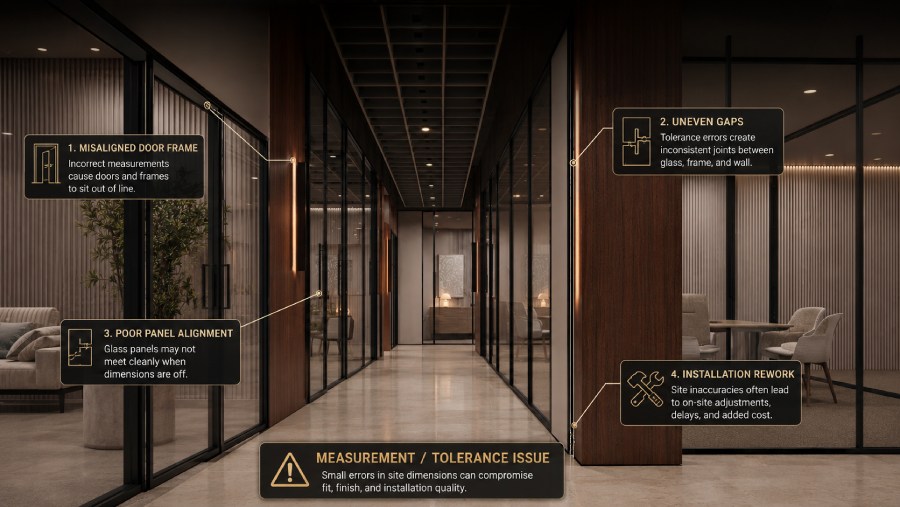
Site measurement errors are among the most preventable yet costliest failures observed on Dubai glazing projects. The most common cause is sequencing: surveys taken before MEP penetrations are sealed and finishing trades have closed out, leaving glass dimensions calibrated to a site that no longer exists at installation. Out-of-plumb walls and slab deflection compound the error, and on frameless partition installations a 3 mm tolerance gap can translate to visible misalignment across a 4-metre run.
Among the most overlooked glass detailing tips on Dubai sites is the discipline of delaying the final survey until all wet trades are complete and structural settlement has stabilised. Laser measurement and digital templating are now standard practice for any frameless or large-format installation.
#4: Poor Edge Work and Cutting Quality
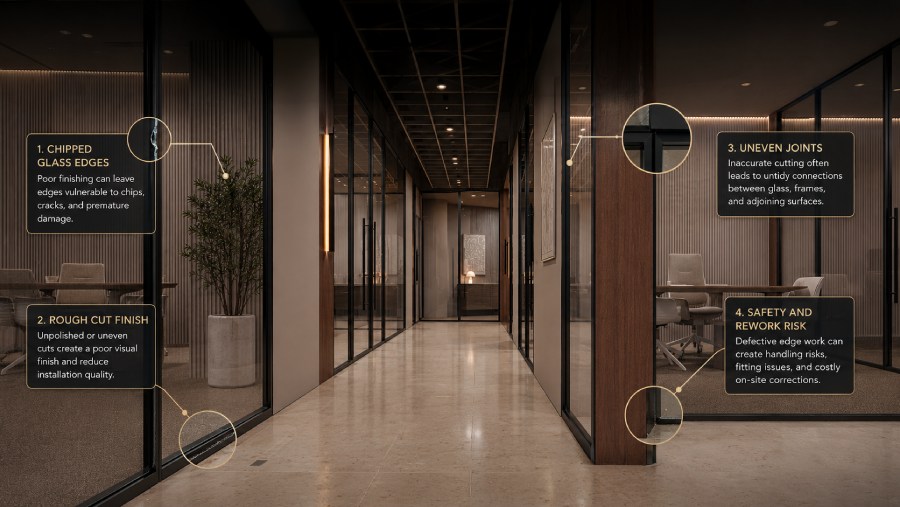
Edge quality determines whether tempered glass holds its rated strength or fails prematurely under load. Chipped, scored, or unevenly polished edges concentrate stress and become initiation points for cracks that propagate weeks or months after installation, long after the contractor’s site presence has ended. The problem is particularly acute on frameless partitions and shower enclosures, where the edge is fully exposed, and any imperfection is both visible and structurally consequential.
CNC-finished edges, polished to a flat-ground or pencil-ground profile depending on the adjoining hardware, are the standard for any project where appearance and longevity carry weight. Visual inspection before delivery to the site, not after installation, is the single most effective control on edge quality.
#5: Substandard Aluminium Profiles and Hardware Mismatches
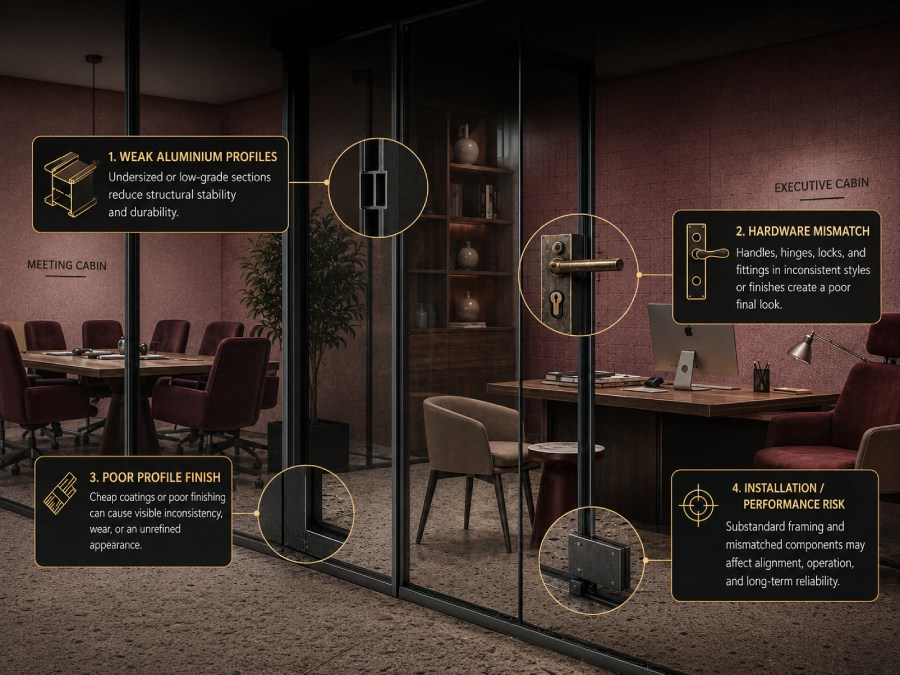
Specification substitution is widespread in the glass and aluminium works Dubai supply chain. Generic profiles are routinely sold as branded systems, and unverified hardware is paired with high-performance glass that it cannot structurally support. The consequences are predictable: thermal breaks omitted on external glazing drive cooling loads beyond design tolerance; hinges under-rated for door weight fail within twelve to eighteen months of handover; and dissimilar metals installed in close contact corrode rapidly in coastal humidity.
The defence is documentation. Demand system datasheets rather than brochures, verify hardware load ratings against actual glass weight, and confirm that every metal interface is either isolated or material-matched to prevent galvanic reaction.
#6: Sealant and Silicone Failures
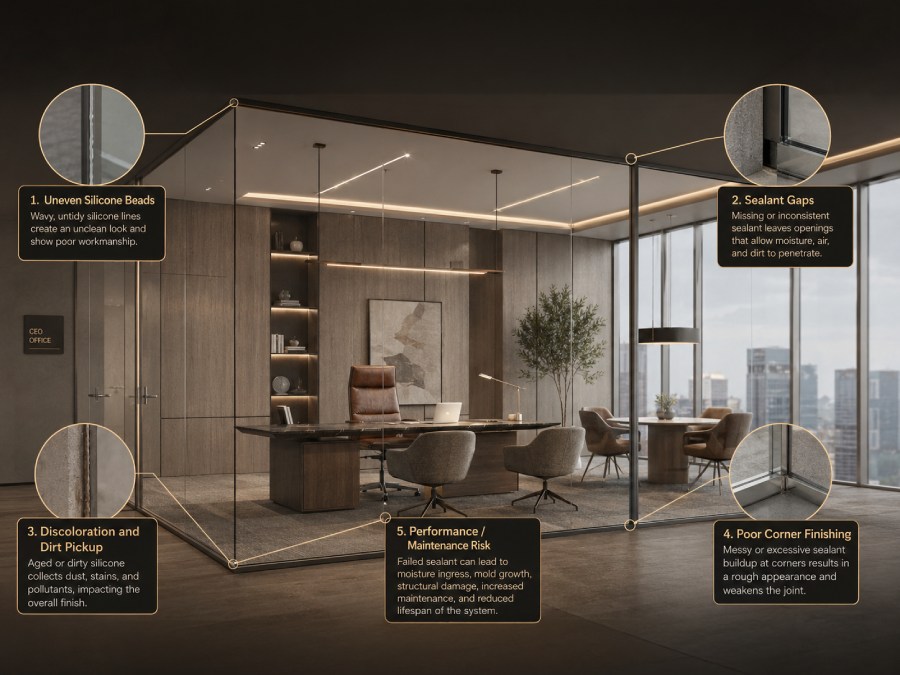
Silicone selection and application errors are the most frequently overlooked sources of glass failure in Dubai’s climate. Neutral cure silicone is regularly applied where a structural grade is specified, joint widths are designed too narrow to absorb thermal movement, and primer is omitted on substrates such as powder-coated aluminium. Application during peak afternoon temperatures accelerates surface cure before depth cure is achieved, producing joints that look acceptable on inspection but fail within two summers.
Joint design should follow ASTM C1193 or an equivalent standard. Confirm silicone-to-substrate compatibility against the manufacturer’s chart, schedule application for early morning conditions, and verify primer specification at the shop drawing stage rather than during installation.
#7: Ignoring Thermal Movement and Expansion Gaps
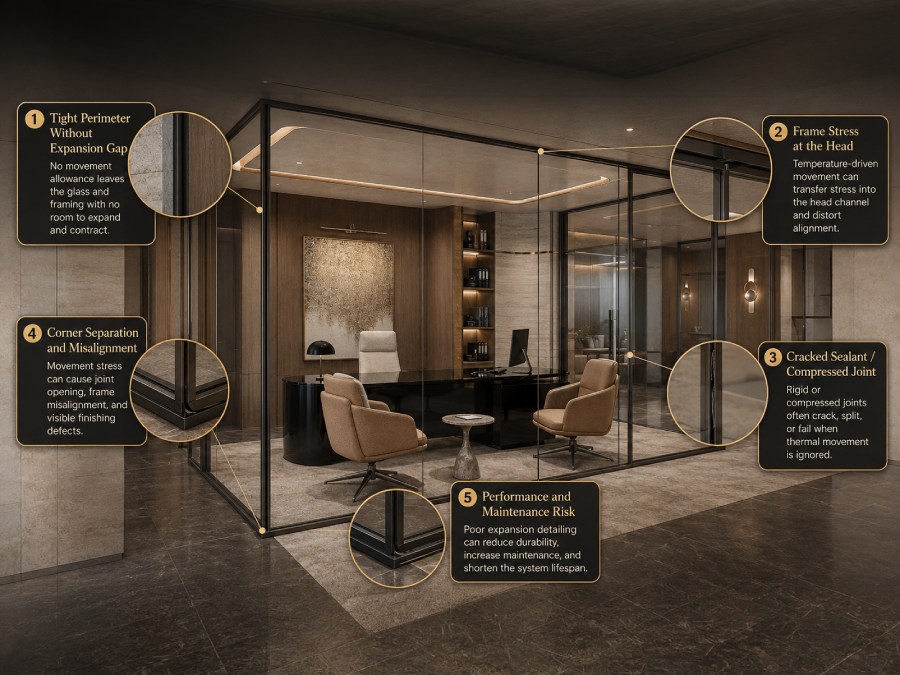
Thermal movement is the failure mode most often absent from Dubai project specifications, and it accounts for a disproportionate share of unexplained glass cracks. Daily temperature differentials between conditioned interiors and external façades exceeding 70°C generate expansion forces that demand engineered clearance, typically 3 to 6 mm per edge, depending on pane size. When glass is installed tightly to the frame, or frames are bonded rigidly to the structure without movement joints, the resulting stress concentration produces edge-origin cracks that often appear weeks after handover.
The control is straightforward. Commission a thermal stress analysis on all tinted, coated, or oversized glass, and install strictly according to the system manufacturer’s clearance schedule.
#8: Skipping Mock-Ups and Pre-Installation Sampling
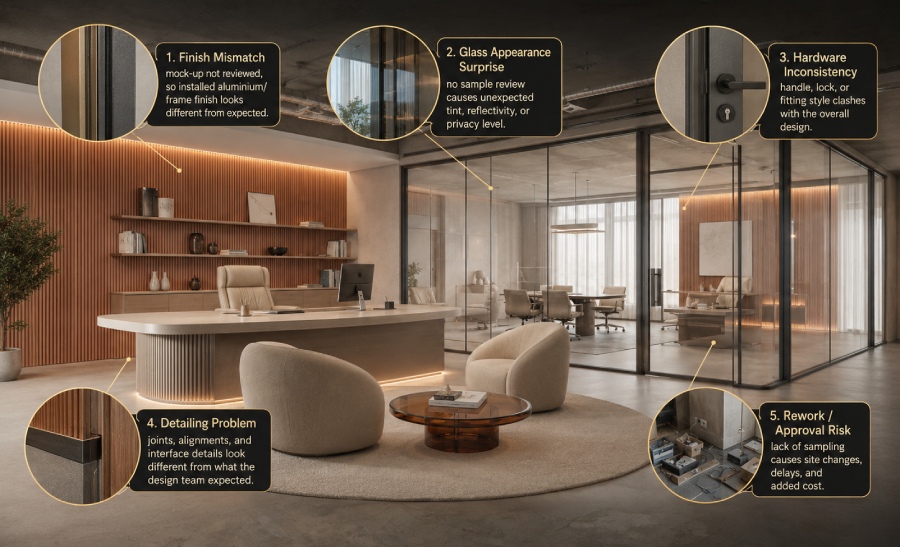
Mock-ups are the most cost-effective form of insurance available on a glazing project, and the most commonly skipped. Without a signed visual sample before bulk fabrication, projects regularly discover hardware finish inconsistency between batches, glass tint variation across adjacent panes, and sequencing errors on stick-built curtain walls, defects that are nearly impossible to correct economically once the material has shipped.
The remediation cost of a single rejected façade panel routinely exceeds the cost of an entire mock-up programme. For any project of meaningful scale, a signed-off mock-up before fabrication release should be treated as a contractual requirement, not a discretionary step.
#9: Treating Acoustic Glass Partitions Like Standard Glass Partitions
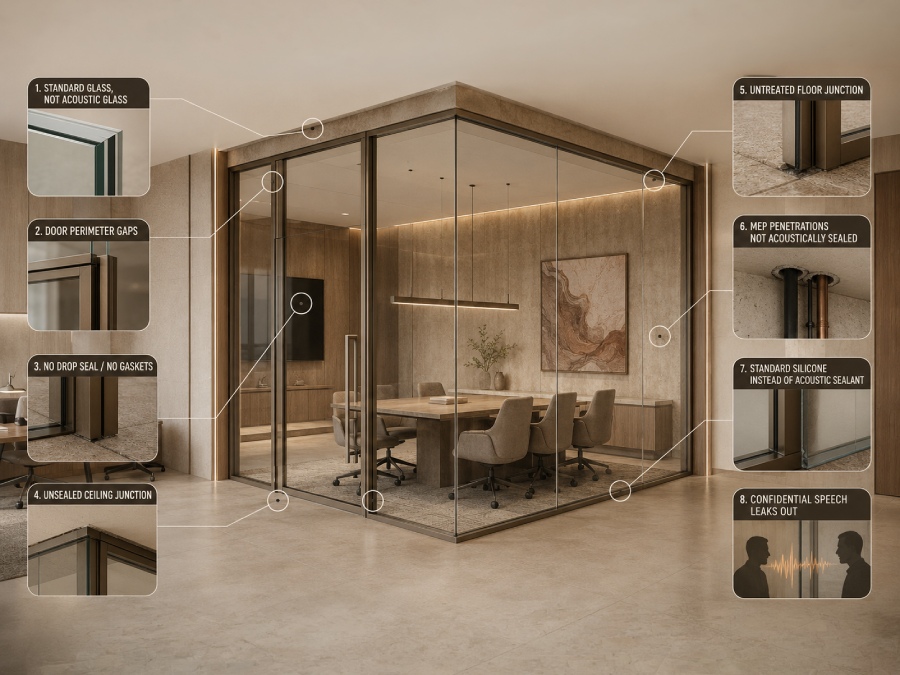
Acoustic underperformance is among the most common complaints about completed office fit-outs in Dubai, and it stems from a single misconception: that any glass partition will reduce noise. Acoustic performance is a system characteristic, not a glass one. Across glass work in Dubai projects, the routine glass installation mistakes Dubai contractors make on office work are the same: gaps at door perimeters, unsealed ceiling junctions, untreated floor junctions, and MEP penetrations sealed for fire but not for sound. The defect rarely shows at handover; it emerges the first time a confidential meeting is overheard through a glazed boardroom wall.
The correct response is to detail the entire acoustic envelope. Specify acoustic-rated laminated or double-glazed units where privacy is required, fit drop seals and full-perimeter door gaskets, treat ceiling junctions for acoustic deflection, and seal all penetrations with acoustic compound rather than standard silicone.
#10: Overlooking Drainage and Water Movement in External Glass Work
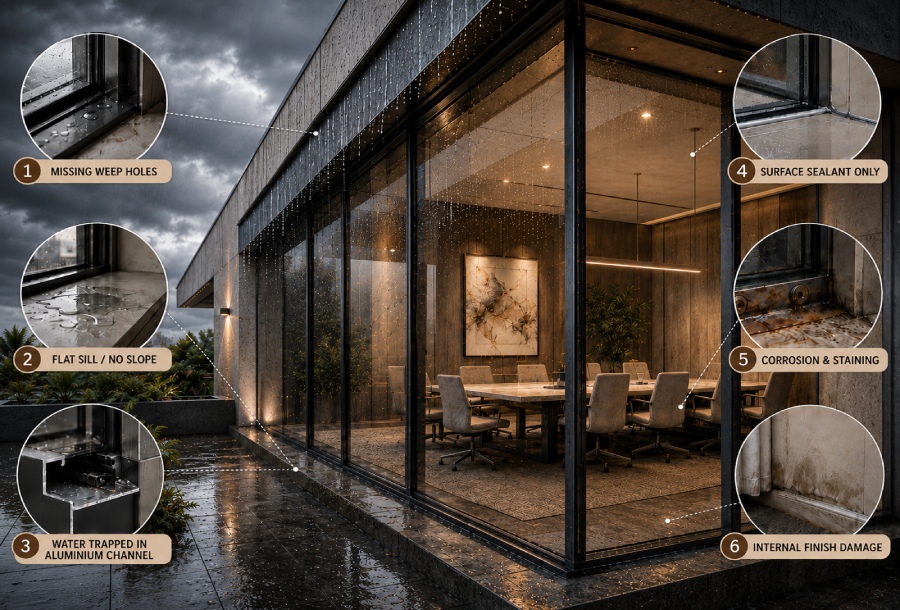
Dubai’s reputation for dry weather conceals a recurring vulnerability in external glazing. Seasonal rainfall is infrequent but intense, and when wind-driven rain strikes a poorly drained façade or sill, the consequences are immediate. Among the installation errors most often seen on Dubai façade projects are missing weep holes, flat sills without engineered slope, perimeter sealant relying entirely on surface adhesion, and aluminium channels that trap water rather than evacuate it. The damage rarely shows in the first season; it accumulates as hardware corrosion, staining at sill returns, and gradual failure of internal finishes adjacent to the glass line.
The defence on any external glass work in Dubai is to design drainage as a deliberate detail, not a default. Specify weep holes and engineered sill slopes at every horizontal aluminium section, select exterior-grade sealants rated for UV and water exposure, inspect curtain wall joints, window perimeters, and balcony interfaces against the approved shop drawing, and never rely on surface sealant as the primary water barrier.
#11: Treating Glass as a Standalone Trade Instead of a Coordinated One
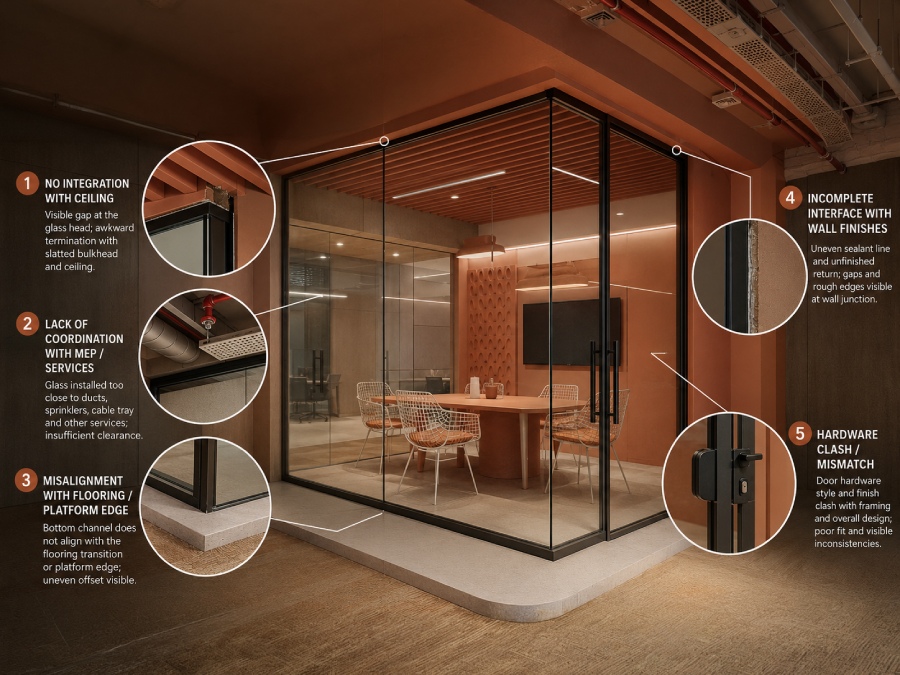
Glass installation in Dubai is too often procured as an isolated package, with no formal interface management between the glazier, the joiner, the aluminium contractor, and the MEP teams operating within the same envelope. The result is predictable: installers arrive after ceiling levels have changed, flooring thickness diverges from drawings, MEP outlets clash with glass lines, joinery and reception counters interfere with partition runs, and door swings sit out of alignment with final furniture layouts. Last-minute site adjustments then compromise the original specification and frequently void the system warranty.
The most actionable glass detailing tips for project managers reduce to a single principle: treat fabrication release as the point at which the site layout is frozen, not a stage at which it can still be revised. Distribute shop drawings to fit-out, ceiling, flooring, MEP, and joinery teams in writing, verify site readiness before production begins, and schedule formal coordination meetings on any commercial project of scale. Single-source accountability resolves what remains: when glass, aluminium, and joinery are detailed and delivered by one contractor working from a coordinated set of drawings, interface defects largely disappear, because no second party exists to disclaim them.
#12: Choosing the Cheapest Glass Contractor Over the Right One
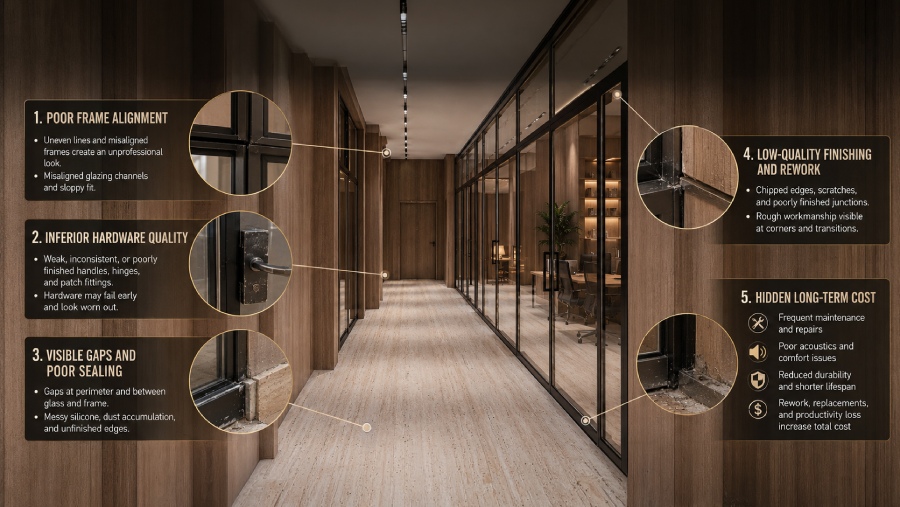
The lowest quote on a Dubai glazing tender is rarely the lowest total cost of ownership. Bids that significantly undercut the market median typically conceal substitution at material specification, omission of mock-ups, abbreviated installation programmes, or the absence of post-handover service. The compound cost, rework, warranty disputes, replacement glass, programme delay, and reputational exposure on visible defects routinely exceeds the original saving by a multiple of three to five.
Before signing, request evidence on four points: in-house fabrication capability, separate system and workmanship warranties, completed references on comparable project scale, and a defined post-handover service protocol. The right contractor will provide all four without prompting.
The mistakes detailed above share a single root cause: glass detailing treated as a finishing trade rather than an engineering discipline. Timbergloss approaches every project from the opposite premise: specification, fabrication, and installation managed under one accountable workflow from a 30,000 sq ft Dubai facility, using European-sourced materials and in-house CNC capability.
To review your specifications or commission a project consultation, contact Timbergloss directly.