


Floor-to-ceiling glass does something no other material can. It pulls the garden into the living room and fills a villa with daylight from sunrise to sunset. Then July arrives.
If one room turns unbearable by three in the afternoon while the rest of the house feels fine, your air conditioning isn’t the fault. The glass is; or the frame holding it, or the fact that nothing outside is stopping the sun before it lands on the pane. Big glazing works beautifully in a Dubai villa when it’s specified properly; we’ve covered the wider case for glass in Dubai villas elsewhere. This guide deals with the heat.
Here’s what actually reduces heat gain through large windows in a Dubai villa: where solar-control glass and Low-E fit, what double glazing does and doesn’t solve, when film beats replacement, and why the aluminium frame matters as much as the glass in it.
Why Do Large Glass Windows Get So Hot in Dubai?
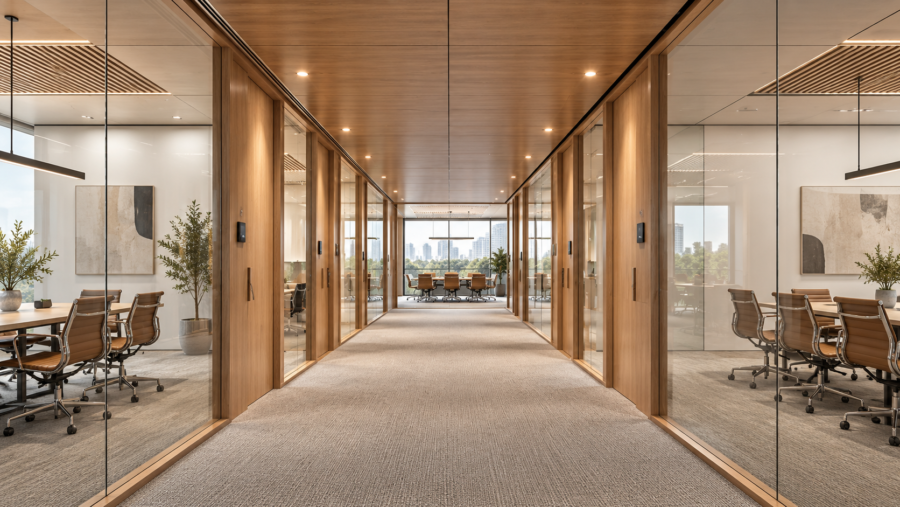
Glass doesn’t create heat. It lets it in.
Sunlight isn’t one thing; it’s visible light, infrared, and UV arriving together. Clear glass transmits most of it straight through. That energy hits your porcelain floor and your furniture, which absorb it and re-radiate it as long-wave heat; the same glass is far worse at letting it back out. The room becomes a collector.
Orientation decides how bad it gets. West and south-west glazing takes the afternoon sun at a low angle, so a balcony or overhang above the window catches almost none of it. That’s the window still radiating heat at 8 pm, during your AC’s longest cycle of the day.
The frame counts too. Aluminium conducts heat far better than glass, so a profile without a thermal break becomes a bridge carrying outdoor temperature into the room. Tired gaskets add to it; an old slider that’s dropped on its rollers leaks conditioned air along its whole length.
None of this is one problem. Glazed area, orientation, glass specification, coating, frame, and shading stack on top of each other, and most specifications only address one of them. Your AC isn’t underpowered. It’s outnumbered.
7 Ways to Stop Large Windows From Overheating a Dubai Villa
Most villas need two or three of these working together, not one:
- Upgrade to solar-control glass
- Add a Low-E coating
- Move to double-glazed units
- Specify thermally broken aluminium frames
- Shade the glass externally
- Apply solar-control film to existing glazing
- Add interior blinds or automated shading

1. Upgrade to Solar-Control Glass
Solar-control glass carries a metallic coating that reflects and absorbs a large share of incoming solar energy before it reaches the room, while still letting daylight through.
The mistake here is choosing by appearance. Darker or more reflective glass doesn’t automatically mean better solar control; a heavily tinted pane can block your view and your daylight while still admitting more heat than a clearer, better-coated product. Ask for the tested SHGC and visible light transmission figures, not the colour swatch.
2. Add a Low-E Coating
Low-E means low emissivity. The coating reduces radiant heat transfer through the glass, which cuts what escapes in winter and what conducts in during a Dubai summer.
But “Low-E” on a quotation tells you almost nothing on its own. There are Low-E coatings built for cold climates that do very little for solar gain, and solar-control Low-E products engineered for exactly this problem. Ask which one you’re being offered, and where the coating sits in the build-up.
3. Use Double-Glazed Units
An insulated glass unit puts two panes on either side of a sealed cavity, usually filled with argon. It slows conductive heat transfer and noticeably reduces road and pool-pump noise.
What it doesn’t do is stop solar radiation. Two panes of clear glass with a cavity between them still let the sun straight in. Double glazing is a construction method; solar control is a performance characteristic. You need both specified, and they’re not the same line on a quote.
4. Choose Thermally Broken Aluminium Frames
High-performance glass sitting in a plain aluminium frame is a wasted specification. Aluminium conducts heat readily, so an unbroken profile carries outdoor temperature straight through to the inside face, and on a twelve-metre slider, that’s a lot of profile.
A thermal break inserts an insulating polyamide barrier between the outer and inner sections, which is why serious glass and aluminium works in Dubai treat the frame and the glass as one specification, not two line items.
5. Add External Shading Where Possible
External shading is the most effective option on this list, because it intercepts solar energy before it touches the glass. Once radiation is through the pane, you’re managing heat that’s already indoors.
Pergolas, aluminium louvres, brise soleil, deep overhangs and motorised external blinds all work. For west-facing glass, vertical or adjustable louvres beat a fixed horizontal overhang; the afternoon sun comes in too low for an overhang to catch.
6. Use Solar-Control Film on Existing Glass
If the glazing is sound and replacement isn’t practical, film is the sensible route. Quality solar-control films reject a meaningful share of solar energy, block most UV, and cut glare, applied to glass you already own.
Two cautions. Film isn’t the equivalent of a high-performance IGU; it’s a retrofit measure, not a specification-level fix. And some films are incompatible with certain tinted or toughened units, so compatibility needs confirming first.
7. Add Blinds, Curtains or Automated Shading
Roller blinds, blackout curtains, solar screens and smart shading all help with glare and comfort, and automated systems can close on a west elevation before the worst of the afternoon.
Treat them as complementary. Interior fabric stops sunlight after it’s already passed the glass, so the heat is inside the room. Useful alongside proper glazing. Not a substitute for it.
Can You Block Heat Without Blocking Natural Light?
Yes. Spectrally selective glazing separates the two; it filters out most of the infrared energy carrying the heat while passing the visible light you actually want. That’s why a bright, clear-looking pane can outperform a dark tinted one. Compare SHGC against visible light transmission, not tint against tint.
Low-E vs Solar-Control Glass: Which Is Better for Dubai?
Wrong question, mostly. They solve different halves of the problem, and in Dubai the strongest specifications use both.
| Feature | Low-E glass | Solar-control glass |
| Reduces conductive heat transfer | ✓ | ✓ |
| Controls solar heat gain | Depends on coating type | ✓ |
| Daylight retained | Depends on specification | Depends on specification |
| UV control | Possible | Possible |
| Best suited to | Thermal efficiency | Strong solar exposure |
| West-facing Dubai glazing | Depends on specification | Usually highly relevant |
| Can be combined | ✓ | ✓ |
The right choice comes from your orientation, glazed area, target SHGC, U-value, VLT, frame system and shading strategy; not from the label on the coating. A north-facing window and a west-facing slider in the same villa can justify completely different glass.
What Is Solar Heat Gain Coefficient (SHGC)?
Solar Heat Gain Coefficient measures how much solar radiation entering through glazing becomes heat inside the building. It runs from 0 to 1, and a lower figure means less solar heat gets through.
Lower isn’t automatically better, though. Push SHGC very low, and VLT usually falls with it, so you gain thermal control and lose the daylight you installed the glass for. On a shaded north elevation, an aggressive solar-control specification is money spent on a problem you don’t have.
Is Double Glazing Enough for a Dubai Villa?
Not necessarily. Double glazing improves insulation, but the glass can still admit substantial solar heat if it’s clear glass without solar-control properties.
For Dubai glazing, the specification needs to cover coating, SHGC, U-value, VLT, cavity width, gas fill, frame thermal break, orientation, and shading. A quotation that says “double glazed” and stops there hasn’t told you what you’re buying.
What About Existing Large Glass Windows?
Replacing glazing isn’t always the right first move. Work through it in this order.
If the existing glass is structurally sound.
Start with solar-control film and a shading assessment. Check the seals while you’re there; a failed IGU shows as condensation or haze between the panes, and film won’t fix that. Frame improvements like new gaskets and adjusted rollers are cheap and often overlooked.
If the glazing is old or single-glazed.
This is where replacement earns its cost. A solar-control Low-E IGU in a thermally broken aluminium system changes the performance of the room, not just the look of it. Half-measures on genuinely underperforming glass tend to get spent twice.
If you’re renovating anyway.
Make the decisions in order: orientation first, then glass specification, then frame, then shading, then coordinate the AC load with your MEP consultant. Choosing glazing after the cooling system is sized is a common and expensive sequence error.
You can see how that sequence plays out across completed work in our glass and aluminium projects
Do Dubai Villa Window Upgrades Need Approval?
Sometimes, and the answer isn’t uniform across the emirate.
It depends on whether the work alters the façade or the approved design, which authority has jurisdiction over your plot, and what your community rules say. Emaar, for instance, requires community approval for villa alterations, and its own guidance notes that changes like closing windows or altering external layouts can need Dubai Municipality approval on top. Dubai Municipality publishes separate categories for building modification, façade treatment, private-villa permits, and maintenance work. A free zone plot may fall under a different authority entirely. The Dubai Development Authority lists two working days as its estimated delivery for a Building Modification Permit, but that figure applies to its own service, not to every villa in Dubai.
Confirm your requirement before anything goes into fabrication. Custom glass and aluminium are made to order, and a permit query after the units are cut is an expensive place to discover it.
How to Specify Glass for a Dubai Villa
Ask any supplier for these in writing before you sign:
- Glass type and thickness
- IGU configuration, cavity width and gas fill
- Low-E and/or solar-control coating, and its position in the build-up
- Tested SHGC, U-value and VLT
- Frame system, profile and thermal break detail
- Spacer type
- Safety classification
- Warranty terms
- Installation methodology
If a quotation comes back saying “premium double-glazed aluminium” and nothing else, that isn’t a specification. It’s a description.
Common Mistakes That Make Dubai Villas Overheat
Most overheating problems trace back to one of these:
- Choosing glass by how it looks. Colour and reflectivity tell you nothing reliable about performance. A dark pane can admit more heat than a clear one with a better coating.
- Assuming thicker glass runs cooler. Thickness affects strength and acoustics. It does almost nothing for solar gain.
- Treating double glazing as the answer. Two panes of clear glass still let the sun through. The coating does the solar work, not the cavity.
- Ignoring the frame. A premium IGU in a plain aluminium profile leaks its advantage through the frame.
- Ignoring orientation. The same glass on a north and a west elevation gives you two completely different rooms.
- Relying on curtains alone. Interior fabric intercepts sunlight after it’s already inside. It manages glare, not heat gain.
- Chasing very low VLT. Cut daylight far enough, and you’ve solved the heat by defeating the point of the window.
- Replacing glass without checking the frame. New units in a tired system underperform from day one, and you’ve already paid for the glass.
Quick Decision Guide
| Your situation | Where to start |
| New villa, large glazed openings | Solar-control Low-E IGU in a thermally broken frame |
| Existing clear glass, sound condition | Solar-control film plus a shading assessment |
| West-facing glazing | High solar-control specification with external louvres |
| Want maximum daylight | Spectrally selective glazing, compare SHGC against VLT |
| Room still hot despite good AC | Assess glass, frame and shading together, not separately |
If you’re coordinating this alongside ceilings, MEP and building approvals, Glass Works in Dubai: A Specifier’s Guidelines covers the full sequence.
Frequently Asked Questions
Ready to work out what your villa actually needs?
Send us your window sizes, elevations, and existing glass specification. We’ll tell you where the heat is coming from and what glass and aluminium system fits the project, before anything goes to fabrication.